recent posts

social media menu

Showing posts with label tips. Show all posts

Make like an interiors magazine: tips from the pros (but don't take it too seriously)

We've covered both the pros and the cons of styling your house to look as picture perfect as a magazine shoot here before. 

While us interiors obsessives may fantasise about having our homes gracing the pages of some glossy magazine, there's always the risk of over-styling – but there are still some basic aesthetics that can make your place sparkle, without taking it all too seriously and becoming a pastiche.

So with that on the table, I'm revisiting a piece I wrote for the Independent a while back on this very topic – but with a bundle of bonus tips we never had room for in the paper: interiors stylists and a photographer give their opinions on how to photo-shoot up your home. But it doesn't have to be for the camera.

One of the many stark rooms featured on the marvellously comforting blog, Terrible Real Estate Photos.

“A photographer’s nightmare,” explains Rachael Smith, who takes very lovely pictures for magazines such as World of Interiors, “is a home with no possessions on show. Editors want ‘detail’ shots – plus nick-nacks make a home a home, create a sense of intimacy.” For the opposite of this, see above.

A "visual vignette" from Selina Lake's lovely book, Pretty Paste Style

“Most photo-shoots capture pictorial vignettes – the sofa, the table, the casually draped throw,” says Beth Worth, who provides affordable home makeovers at lovehousedesign.com. “So it’s not just about furniture; create a little narrative.”


Small, affordable details – flowers, colourful cups, a cushion, a little print and a rug – create "safe" bold in this otherwise neutral kitchen. Also featured in Selina Lake's latest book.

And bold doesn’t equal expensive or scary, believes Beth. “If you’re nervous,” she says, “build on a neutral base, then take risks with accessories: zingy cushions or throws, a fabulous ceramic jar – cheaper than the wrong sofa.”

Rachael’s top tip? “Have a massive spring clean,” she says. “Get rid of all the stuff you don’t need. People keep things they really shouldn’t for sentimental reasons. The amount of cleaning I do in people’s homes before being able to shoot is incredible… especially in bathrooms.”

On the decluttering tip, Rachael underlines the importance of good storage. “But not expensively built-in stuff,” she says. “In a photograph that generally looks really boring. Instead, how about a 50s cabinet from a junk shop to keep your books in? Or a haberdasher’s cupboard for clothes, instead of sliding-door wardrobes. It’s far quirkier and more visually interesting.”

But Rachael’s biggest bête noir is TVs: “They’re so huge these days – and not pretty things. Hide it in a cupboard – and definitely never put it over a fireplace.

With a TV-hiding cupboard, drill a good-sized round hole in a bottom corner to feed the wires and cables through. "A good tip for all pieces of furniture that might be holding electrical equipment, whether hi-fis, lamps or TVs," says Rachael. "There is an increasing number of cable tidies on the market these days. With a little research you can find something that suits your home." Perhaps like this one, above, which we featured a while back.

Emily Blunden, a stylist for magazines including Homes and Gardens and Guardian Weekend, as well as a blogger under the moniker Atticus and Finch concurs: "On one shoot, I saw a TV hidden inside an antique glass cabinet – but with good-looking fabric pinned inside hiding the TV, and brightening the cupboard. Very nice." Or make like designer, Abigail Ahern, who has a fantastically simple TV camouflage idea: if your black TV is wall-mounted, paint that wall black too (pictured above, and here are more of Abigail's style tips).

Wooden crate shelves, above, from Reclaimed Interiors in the US. You can find heaps of wooden crates for sale on eBay.

Contributing ed Abi's jewellery storage, which she wrote about here.

Emily continues: “Investigate different ways of displaying too; different shelving will produce different styles and will require different bits and bobs; printer block units make for lovely shelves, as do old apple crates.”
“Don’t worry about trying to aim towards anyone style or not having the 'right' things or things that go together," says Emily. "There is no right or wrong and the best style is your own personality. And remember – nothing has to be forever.” Hear, hear.

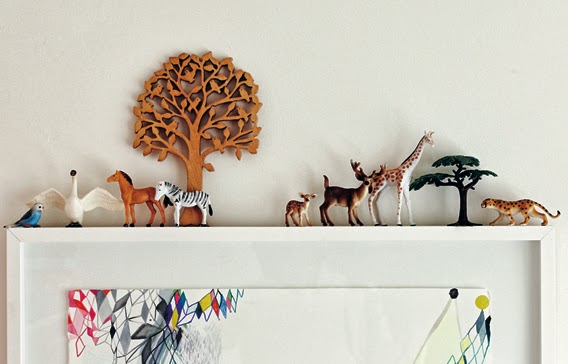
That said, she continues, “There’s a big difference between an obsessive collector and someone who just has nice things. So don’t overdo it. And, by the way, they don’t need to be expensive things... a photogenic house needs personality, it doesn’t need extreme wealth.” The vast photographic tome, A Place Called Home, by Australian stylist Jason Grant is a good place for inspiration on this front. Above, toy plastic animals add affordable character to a framed artwork.

My own top tip, from writing about homes, is not to strive for perfection, as perfectly finished homes can look sterile – magazines are always after a ‘story’: and it’s hard to write one about nothing. Which is why this story from The Kitchn website (a snippet of which is above), about "real" kitchens, is one of my all-time favourites.

How to find inspiration

After moving from a flat to a house, I panicked: I had little furniture, no budget and zero direction. Inspiration was clouded by the threat of expensive mistakes and “blank canvas” panic. It is around this vulnerable state-of-mind that Ikea’s entire marketing strategy is built. Equally, interiors magazines are great, but can exacerbate the panic with their unattainable chic. Where else can one turn?
  1. Inspiration is everywhere, if you’re tuned in. One friend took layout tips from the kitchens in Desperate Housewives, while a bachelor colleague made manly shelves after seeing Steve McQueen’s bedroom in Bullitt.
  2. For cold, hard design tricks – from one-room living to how to arrange “things” on shelves and walls – Conran’s Seventies interiors bible The House Book (Mitchell Beazley; originals and reprints via Amazon) is invaluable and most comforting.
  3. Make a mood board of photos, fabric scraps and magazine pages. A bit sixth-form media project, maybe, but when you’re overwhelmed it can provide focus. Broad themes should gradually emerge (vintage, minimal, lavish, practical, bright, muted, classic?). If not, ask a friend to edit.
  4. Handy with the sticky-backed-plastic? Try the Design*Sponge blog. Even the DIY-shy can get ideas – the box file shelving is a personal favourite, and demonstrates innovative use for the results of a panicky Ikea binge.
  5. Take a favourite picture, object or cushion and build a room around its colours, period detail, or simply a feeling it evokes – it’s easier than starting with infinite choice. Similarly, follow at least a loose theme through all rooms (also helpful for reducing blank-canvas-panic). I got boxy window pelmets from postcards of 1960s American motels, while my mum designed my entire childhood home around a Swedish 19th century artist called Karl Larsson. And Tricia Guild’s book, A Certain Style (Quadrille), is full of clever ways to do this.
  6. Clever storage can free up whole new chunks of room – so don’t underestimate the creative boost of a flick through the Lakeland catalogue. This above-sink shelf, £22.99, is surely absolute genius, no?
  7. Kevin McCloud’s books on colour, divided into sections according to periods, styles and palettes, are immensely practical. Buy at Amazon
  8. Fear of making mistakes can be paralysing. It’s often easier to know what works when faced with something that doesn’t (and that’s what eBay’s for). That said…
  9. Don’t rush things – one stylish acquaintance swears by the picture-heavy Architectural Digest. Not as scary as it sounds, its ‘Inspired by You’ section, where designers answer questions, is fantastic. Soothing sample quote: “The best rooms evolve over time. It is better to have one fabulous chair or table or rug than a whole room of mediocre pieces.” Most comforting.
  10. Tune into your reactions to a space – and that goes for the smallest and least glamorous details: my sitting room used to make me feel strangely on edge. It took months to work out the door opened the wrong way and made one feel claustrophobic whenever it was opened.
  11. Go next door: if you’ve just moved – or even if you haven’t – knock on amenable neighbours’ doors, especially if you’re in a terrace or flat surrounded by similarly laid out homes. Someone will have done something you’d never thought of that may set off a whole room plan.
  12. For major reconfigurations, and pointers on them, big changes, Architect Your Home is a useful service – a four-hour no-strings consultation costs from £599. Cheaper, is to offer dinner in return for your most creative friends’ tips. Get them over, walk them round, and ask everyone ‘what would you do?’ I doubled the size of a bedroom after a friend suggested I have a mezzanine built in the high ceiling.
  13. Far more useful than the magazine, I think, is the LivingEtc.com gallery – libraries full of images, helpfully subdivided to death: the bathroom gallery has five themed mini galleries according to style/type of room.
  14. And if you do get sucked into Ikea, at least try to stick by the 1-for-3 rule (for every three things you like, buy only one – list all the things you wanted to get, and hunt for them elsewhere). If all else fails, try Ikeahacker.blogspot.com

Tricia Guild's tips for living with colour

Images from Designersguild.com
A few weeks ago I interviewed Tricia Guild OBE, whose colourful shop and design business Designers Guild, has been going for 40 years. Chatting with Guild over coffee at the King's Road showroom in London was hugely inspiring (I posted some snaps of the shop at the time) but, as I am still haunted by the garish orange I once painted the front room in my first London flat, wanted to ask the expert for her tips on getting some colour back into my life without creating a headache-inducing mess. Here's what she said...
  • White is fine if you’re decorating somewhere dark – but if it’s dark it’ll still be dark afterwards, just whiter than it was. But it might be wonderful painted a bright colour
  • There’s an idea that in a small room you shouldn’t use pattern. Why? It can be like a little treasure box
  • Don’t use colour on absolutely everything – perhaps have a neutral wall, bricks, an organic sofa, or sisal floors. I usually have pale ceilings – and I do like height and I think it does help the space
  • Using different patterns doesn’t equal clashing – but make sure the colours work between one pattern and another
  • Having said all that, I really don’t like rules, because you can always find a way of turning them on their head
Tricia's new book, A Certain Style is £27.47 from Amazon and features 14 of her interior design projects, all vastly different - but all exquisitely colourful. Really makes you look at things differently at home - or it did me, see below...

Betty Draper's kitchen

If the early sixties style in Mad Men does it for you - Retrorenovation, which I just stumbled across, might be a little too exciting. 

The How To Recreate Betty Draper's Kitchen feature, particularly so...

The site spans the 1940s to the 1970s, spotlighting authentic interiors style. The gallery is mind-bogglingly

brilliant he tips are exhaustive and the forum full of equally obsessed retro nuts. If only the shopping pages weren't all American...

I'll do what I can to post up a healthy selection of UK-friendly resources - for starters, check out Formica Limited's reproduction line, where they manufacture vintage formica designs and sell them by the roll.

I bought some Yellow Grafix (left) and had my kitchen worktops covered in it.

My top online interiors and DIY resources

I'll update this regularly and begin to organise it into sections as it grows, so you can be bursting at the seams with every resource you and your home could ever need...
Thefrenchhouse.co.uk Not cheap. But quite lovely antique French/French-inspired furniture and salvaged gems. They re-upholster and offer other sprucing services depending on what you're after. If you can't afford them, the shop is still great for inspiration. Check out their 1920s-1950s bevelled mirrors. I found one just like it in my local Cancer Research shop for £15.
Sourceantiques.co.uk An eclectic selection of reclaimed furniture and architectural salvage, featuring everything from entire kitchens to vases. Perfect if you want a one-off but don’t have time to trawl flea markets or the patience for ebay bidding.
Lighting-direct.co.uk While feature lamps are more of a design choice, plain wall or kitchen lighting that isn’t vile is hard to find. This place has some tat – but browse well and its vast selection will provide those essentials.
Funkylittledarlings.co.uk Not clever enough to paint your own children’s walls with something fun and fabulous? This wallpaper place – which also offers a bespoke design service – is the answer.
Retrotogo.com 50s and 60s design is having quite a moment right now. This site collects the best bits and provides links to relevant retailers.
Screwfix.com Boring but essential if you’re DIY-ing. This trade-price site sells (obviously) screws, but also Leyland paint, tools, radiators and halogen spots.
Doorchimesuk.co.uk Why are doorbells frequently so naff? Where on earth could you replace that tacky plastic thing with, say, a state of the art Jacob Jensen digital dream of a doorbell? Here.
Artscouncil.org.uk/ownart A house-full of new contemporary artwork to match your home’s new look isn’t something you might have budgeted for. This service provides interest-free loans so you can afford to do it.
Dandys.org The best selection of reasonably priced garden or driveway gravel on the internet, selling and delivering nationwide everything from plum slate to recycled rubber chippings.
Architect-yourhome.com The place to go if you can’t afford an architect to run a whole project, but could do with some affordable expert advice, inspiration and to-scale sketches.
Bathstore.com Stylish bathrooms on a budget – and spectacular customer service.
Greenhomesconcierge.co.uk For £200 they’ll give you a HIPs-ready report, rate your home’s energy efficiency and be on call for a year to organize and source relevant workmen and products. Worth it if you’re ripping out and starting from scratch.
More to come...